The CHAI Design by Agency toolkit
We are very excited to share the CHAI Design by Agency toolkit. This work is supported by Oxford University’s IAA and Innovate UK, and developed in collaoboration with FamStudio.
The CHAI (Designing for Children’s Agency in AI) framework provides a conceptual framework that helps design teams reason explicitly about children’s agency during the design process.
By agency, we refer to the ability to make meaningful choices, act with intention, and influence one’s own experiences, which is foundational to children’s development. However, in practice, agency is rarely considered systematically when designing AI systems for children. Design teams tend to rely on implicit judgements, focus narrowly on safety, or treat agency as an abstract principle rather than something that can be mapped onto concrete system functions.
The CHAI framework addresses this gap. Rather than prescribing specific design solutions, it provides a structured way to surface assumptions, articulate trade-offs, and connect values to design decisions.
Core Concepts
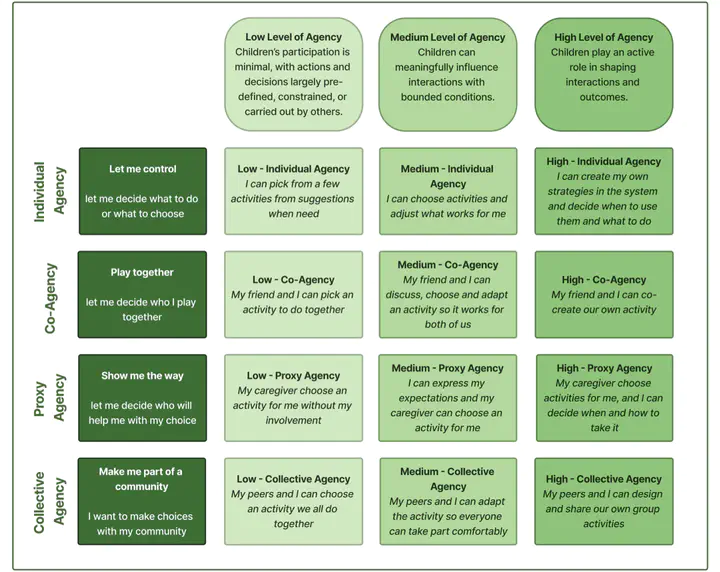
The CHAI framework distinguishes four types of agency, drawn from Bandura’s social cognitive theory. These function as reasoning lenses — they prompt you to consider how agency is distributed across different stakeholders in your system.
Individual agency: the child’s capacity to make choices and act independently within or through the system.
Co-agency: control, responsibility, and influence over outcomes are shared between the child and others such as a parent, peer, or teacher.
Proxy agency: others act on the child’s behalf (e.g. parents configuring settings), while the child’s voice and preferences should remain represented.
Collective agency: children act together with peers, families, or communities to influence shared outcomes through coordinated effort.
It also uses three levels of agency (low, medium, high) to describe the degree of children’s involvement, expressed from the child’s point of view. Importantly, higher is not always better — trade-offs are inherent and children’s best interests should guide decisions.
A four-stage reasoning process
Inspired by the EbD-AI framework, CHAI supports designers through:
- Assessment (articulating agency-related design goals and clarifying which forms of agency are valued, for whom, and why);
- Mapping (linking agency types and levels to concrete system components and interactions via an agency mapping matrix);
- Application (selecting consequential system functions and exploring redesigns to better support agency);
- Reflection (examining how reasoning evolved, surfacing tensions and constraints, and preparing for implementation).
The CHAI framework materials, including workshop templates, the agency mapping matrix, and case study examples, are openly available at: https://github.com/junszhao/ethical-design.
A full documentation of our evaluation of the framework can be found in our arXiv paper here.
We would love to hear your feedback and through with the framework.

OxfordCCAI
Organisation
Oxford Child-Centred AI (Oxford CCAI) Design Lab assembles a series of research activities related to designing better AI for and with children. It is part of Human-Centred Computing at the Department of Computer Science at the University of Oxford.