Special issue editorial published at IJHCS
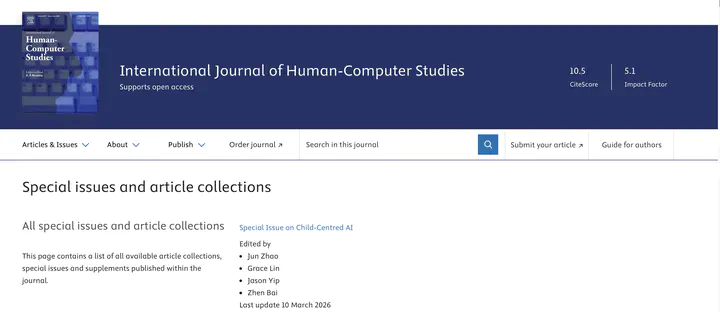
We are delighted to share that our special issue editorial has been accepted for publication at IJHCS.
This special issue aims to explore a challenge that has become increasingly crucial as artificial intelligence becomes embedded in the lives of children: how should a more balanced, child-centred, and agency-focused approach to designing AI systems for children look like?
The special issue assembles nine pieces of frontier research, presenting a wide range of state-of-the-art research related to AI and children through the exploration of:
- new ways of supporting children’s critical AI literacy and understanding by Kim et al. (2025); Zhou et al. (2025); Wilson et al. (2025);
- creative approaches of using AI to support children’s learning by He et al. (2025); Vargas-Diaz et al. (2025); Zha et al. (2025);
- new design methods with children by Wilson et al. (2025) and Zha et al. (2025);
- fostering children’s social and emotional development by Fan et al. (2025);
- creating child-centred AI technologies by enhancing privacy preservation by Dutta et al. (2025).
All accepted articles under the special issue can be viewed here.
This body research has highlighted a set of key themes in the current research towards a balanced, child-centred, and agency-focused AI for children, including:
- An emphasis of transitioning from passive protection to supported autonomy
- Designing for co-agency rather than replacement
- Play, creativity, and exploration as core design values
- Agency being developmentally and contextually grounded
This special issue also highlighted critical directions for future research, including:
- Advancing awareness and conceptual clarity around children’s agency in AI design
- Accounting for relational and social dimensions of child–AI interaction
- Integrating agency and ethics as complementary design goals
- Amplifying children’s voices in the design of ethical AI systems
We thank all the reviewers, contributing authors, and IJHCS editor-in-chief, Professor Duncan Brumby, who have made this special issue possible.
We are also pleased to announce the open call of a new special issue at International Journal of Child-Computer Interaction, led by OxfordCCAI, with a closing date of 27 October 2026.

OxfordCCAI
Organisation
Oxford Child-Centred AI (Oxford CCAI) Design Lab assembles a series of research activities related to designing better AI for and with children. It is part of Human-Centred Computing at the Department of Computer Science at the University of Oxford.